

 Michael Gustafson
Qnect in MSC Need for Speed Special Segment
 Pearl Burgoff : Dec 1, 2022, 12:00:00 PM
Read about Qnect's software in Modern Steel Construction's "Need for Speed" special segment.
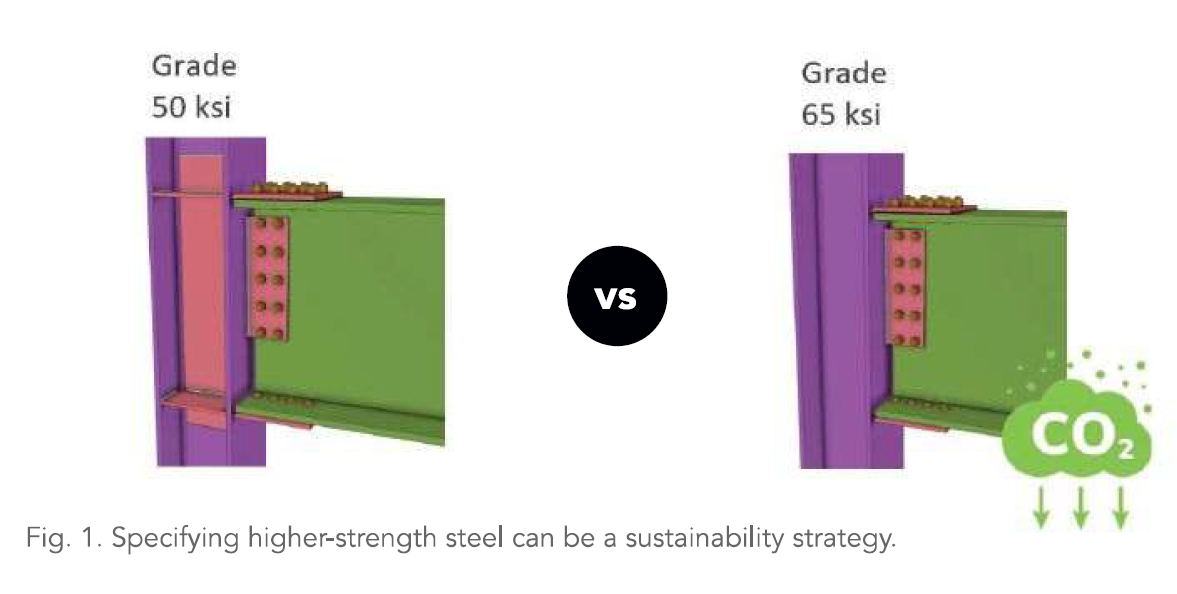
When considering sustainable design strategies, embodied carbon reduction is often the top priority. Choosing domestic structural steel and its sustainability-friendly electric arc furnace production is a primary embodied carbon reducer for a steel project. But it is not the only method through which structural engineers can influence a project's embodied carbon. Design choices - such as connections and connection design methods - also impact embodied carbon, as do fabrication and erection speed.
Structural engineers can make a greater impact on global carbon emissions than the average citizen. Steel and concrete-two materials they use in design-account for about 15% of worldwide global warming potential (GWP), according to Architecture 2030. Based on that percentage, optimizing structural designs by even a small margin would lead to a notable impact on GWP reduction.
Sustainable design guidance is increasingly available and thorough. AISC's Sustainable Steel: A Comprehensive Guide for Project Teams, for example, will be released in late 2026. Another significant under-taking was structural software developer Qnect's recent two-year Small Business Innovation Research (SBIR) grant in collaboration with the U.S. Army. Qnect partnered with Turner Construction, Nucor, and fabrication machinery provider FICEP to validate embodied carbon design strategies and assumptions, with AISC providing feedback. This article summarizes its findings and offers some strategies for optimizing designs for cost and embodied carbon beyond the framing choice.
While the steel industry maintains robust data for steelmaking (A1) and mill-to-fabricator transport (A2), precise metrics for fabrication (A3) and erection (A5) lack granularity. The U.S. Army SBIR research focused on dissecting these phases to establish reliable defaults within Building Information Modeling (BIM) software. To aid engineers in comparing cost and carbon for steel framing and connections, structural engineering firms involved in SE 2050 were interviewed to identify the most effective visualization frameworks to compare cost and carbon. The technology already integrated into Tekla Structures was implemented in Autodesk Revit.
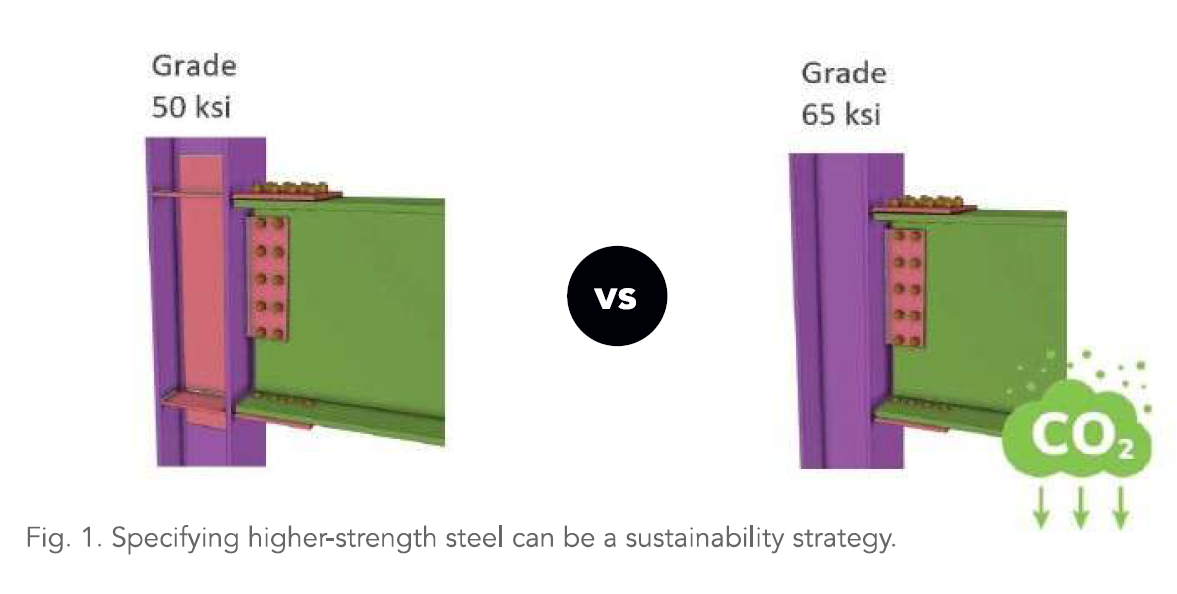
The project's goal was to equip engineers with tools to optimize framing within the context of connections. For example, engineers are taught to upsize their columns to eliminate doublers and stiffeners, which add cost. Material is cheap, while connection complexity comes at a cost. But how does that decision change when embodied carbon impact is a top priority for the client? How does high-strength steel factor into reducing cost and carbon (Figure 1)? Engineers deserve legitimate data to help them make these decisions.
Qnect's research documented carbon factors by material, fabrication, and erection. Much of the data for A3 was calculated through research on energy consumption per fabrication process.
Steelmaking and Mill-to-Fabricator Transit (Al-A2). The steel production phase remains the primary driver of environmental impact, accounting for 80% to 90% of total embodied carbon for structural steel. Default values use industry-average EPDs developed by AISC and found at aisc.org/e. For example, a wide-flange has an industry-average baseline carbon factor of 898 kg CO2e per metric ton, compared to 1,480 kg CO2e for steel plate and 1,710 kg CO2e for Hollow Structural Sections (HSS).
Fabrication Processes (A3). Nucor's recently published research about steel fasteners shows that bolts are over twice as carbon-intensive as hot-rolled structural steel sections at 2,320 kg CO2e per metric ton. This results in a typical ¾-in. by 2½-in. bolt assembly responsible for approximately 0.74 kg CO2e.
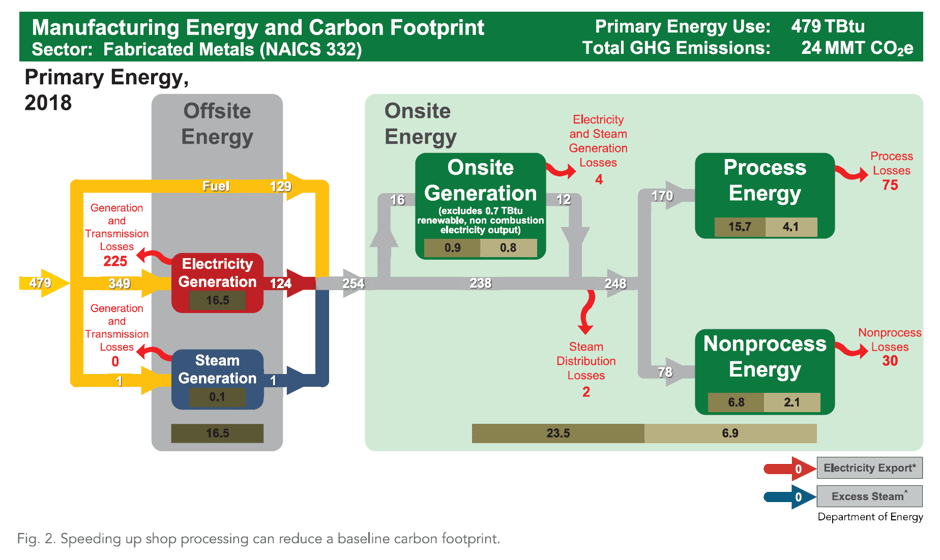
Welding processes vary greatly in the energy they use and the greenhouse gases they emit. For example, a ¼-in. fillet weld instead of a weld CJP on a heavy member that requires preheating results in a ten-fold difference in energy use and carbon emissions. To find that number, energy consumption for fabrication processes was estimated using a machine-specific, bottom-up method. Power-load profiles were cross-referenced against the U.S. Department of Energy (DOE) Manufacturing Energy and Carbon Footprint sector-wide aggregate data. Carbon intensity of fabrication operations was normalized using the EPA eGRID national average grid emission factor for the relevant calendar year. Use of high-strength steel (65 ksi) can reduce the need for preheating, which also reduces kg CO2e.
The actual energy and carbon emissions from fabrication activities like drilling and punching are much lower than those from coping and cutting. When a beam is coped, energy is used to cut the cope, and the waste itself represents carbon emissions. The coped material can be recycled, but energy still went into its production. Therefore, from an embodied carbon perspective, there is no benefit to coping members.
Jobsite Activities (A5). On the jobsite, the energy used to field-bolt is negligible. Spinning a nut consumes a mere 0.0016 kg CO2e, meaning the bolt's material carbon is 650 times greater than the energy required to install it.
However, field welding has a much bigger contribution. Because jobsite welding commonly relies on diesel generators emitting roughly 1.0 kg CO2e per kWh, according to the EPA's eGRID database, field welding is three times more carbon-intensive than shop welding. Furthermore, jobsite diesel generators frequently idle between active weld arcs, contributing more embodied carbon.
Though the carbon impact from bolt material for a given steel assembly is much less than that of the beam or column, but the impact on cost and schedule is not. Labor costs to install bolts in the field in major cities can be over $100 per bolt. The same goes for welding labor costs, especially when preheating is needed.
The centerpiece of Qnect's collaboration with FICEP involves transitioning from speculative energy equations to actual shop-floor analytics. Using FICEP's Steel Projects PLM software, loT data collection, and SKYLAB monitoring systems, the research tracked the exact kilojoule (kJ) consumption of machinery operations during punching, drilling, sawing, and coping.
As a benchmark, Qnect evaluated carbon-emission research on steel manufacturing facilities conducted by the DOE. The DOE's shop-floor monitoring confirmed that actual machine preparation and processing activities account for about 50% of a fabrication facility's total emissions. The remaining 50% is consumed by fixed overhead systems, such as facility HVAC, lighting, and compressed air systems.
The machine processing data leads to a crucial operational realization: energy impact from a specific drill bit or plasma arc is less important than optimizing for fabrication throughput because speed inherently minimizes the facility's fixed overhead run-time allocated to each ton of steel. By speeding up shop processing, fabricators substantially reduce the baseline carbon footprint of their operation (Figure 2).
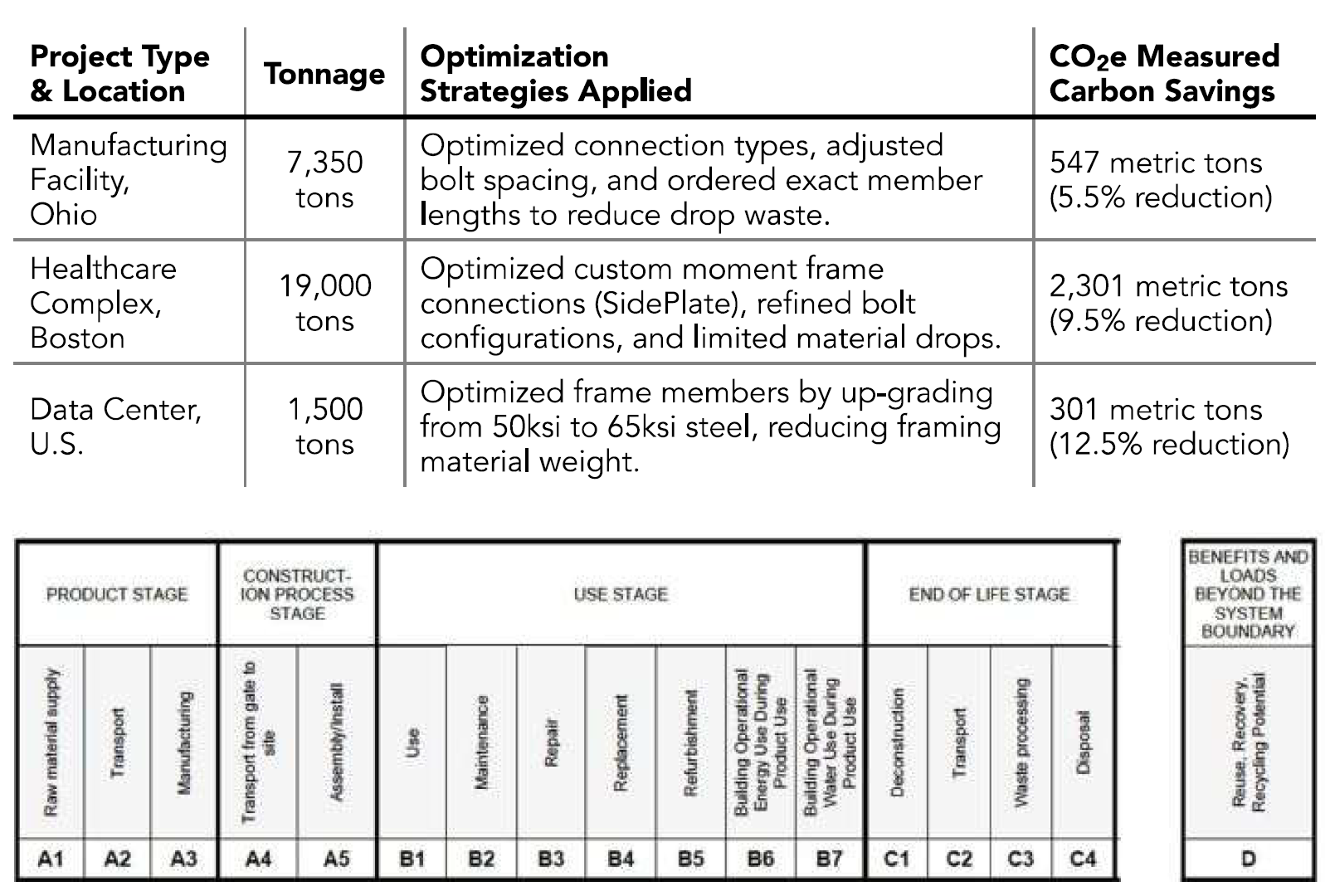
To validate these integrated cost-carbon algorithms, large-scale projects were analyzed using real industry-average datasets applied to connection material and framing. Material, fabrication, and erection carbon factors were applied. In future projects, the goal is to validate estimated carbon values with actual carbon values validated through shop and field measurements.
To turn these insights into actionable carbon savings, structural engineers must target the pillars of structural design optimization. True carbon minimization requires a deliberate, hierarchical approach starting at the macro level:
• Efficient Structural System Topologies: Engineers must design leaner geometric configurations that inherently
minimize structural demands. Choosing layouts and structural systems that reduce load paths directly limits the baseline volume of raw material required.
• High-Strength Material Grades: Upsizing standard frame members from 50 ksi to high-strength 65 ksi or 80 ksi steel represents a massive carbon reduction mechanism because there is no significant embodied carbon increase when upsizing to higher steel grades. By leveraging higher yield strengths, engineers can specify lighter profiles, directly reducing mill emissions that dominate the total lifecycle footprint.
• Connection Rationalization: Designing clean, optimized connection types allows for the systematic removal of material-heavy additions like stiffeners, doublers, and other framing reinforcements. Minimizing overall bolt intensity and replacing field welds with shop-fabricated alternatives directly transforms the carbon profile of the project.
The structural steel industry is also re-evaluating delegated design and the role of connection modeling in the design lifecycle. The conventional design-to-construction sequence frequently hinders material optimization. Traditionally, structural engineers deliver 2D designs to bidders, pushing connection detailing to later in the schedule during the detailing phase. This systemic disconnect routinely leads to a costly reality: approximately 70% of construction projects finish over budget or are delayed, according to the Lean Construction Institute. Structural configurations frequently carry up to 50% excess material, according to Institution of Structural Engineers research from 2023.
By resolving connection concepts early in the design phase and before steel is ordered, project teams gain the geometric and structural certainty required to optimize frame material, minimize fabricator drop waste, and accelerate erection schedules. Ultimately, transitioning to an Early Connected Model (ECM) framework transforms connection design from a late-stage task that generates RFIs into a proactive mechanism for optimizing a project's total cost and carbon footprint.
While the industry has successfully closed the data loop on stages A1 through A3, the final frontier of tracking jobsite-specific embodied carbon (AS) remains relatively unmapped. In the UK, current lifecycle data from the Royal Institution of Chartered Surveyors indicates that installation and site activities can account for 10% to 20% of core material-stage emissions.
Fortunately, forward-thinking general contractors are starting to clear this fog. Industry leaders like Turner Construction are actively measuring jobsite carbon foot-prints alongside transport logistics (A4) by leveraging comprehensive material-tracking frameworks, such as Building Transparency's EC3 database.
As global environmental frameworks begin mandating rigorous data transparency via tools like Digital Product Passports, carbon tracking will mature from a voluntary sustainability metric into a critical economic asset. By grounding early connected models in empirical shop data, structural engineers, general contractors, and fabricators can confidently navigate this shifting terrain together, proving that sustainability benefits can be equally outstanding for the project budget.
----
About the Author:

Michael Gustafson (mgustafson@qnect.com) is the senior vice president of strategic growth at Qnect
--- Originally published August 2026 in Modern Steel Construction magazine ---
 Pearl Burgoff : Dec 1, 2022, 12:00:00 PM
Read about Qnect's software in Modern Steel Construction's "Need for Speed" special segment.

 Michael Gustafson : Jul 13, 2023, 11:24:00 AM
Discover how engineers can cut embodied carbon by tackling overdesign and risk. Learn impactful strategies. Start reducing excess today! Read more...

 Jef Sharp : Dec 12, 2023, 3:18:13 PM
Every bolt counts. It is important to recognize that saving seemingly small amounts of steel on a project accumulate to massive quantities and...